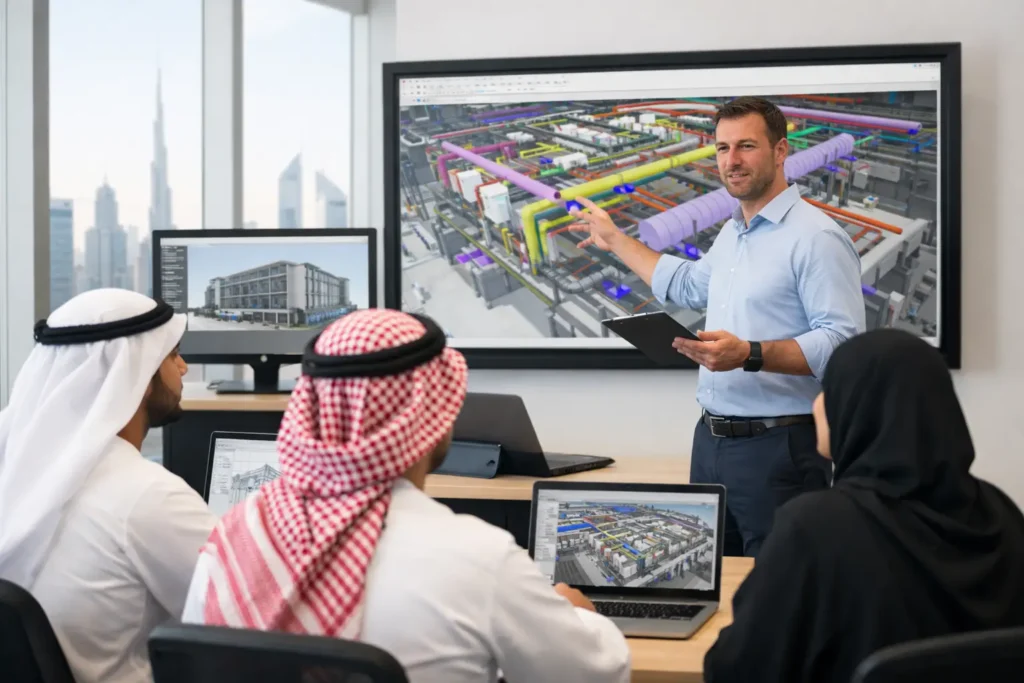
A BIM coordination training course is not simply a software class. It is preparation for the moment when architectural, structural, and MEP models meet on a real project – and the team needs someone who can identify conflicts, organize information, communicate decisions, and keep construction moving forward.
For engineers, architects, draftsmen, and BIM professionals across the UAE and GCC, coordination capability has become a career differentiator. Contractors and consultancies need people who can work beyond model creation. They need professionals who understand federated models, clash detection, model review meetings, issue tracking, documentation, and disciplined collaboration across every trade.
What a BIM Coordination Training Course Should Deliver
A strong BIM coordination program connects software knowledge with project responsibility. Learning Revit alone can help a professional build intelligent models. Coordination training teaches what happens after those models are shared: how to combine disciplines, assess model quality, find clashes that matter, assign issues to the right team, and report progress in a way that site teams and project managers can act on.
At CADD International Sharjah, BIM learning is designed around practical AEC workflows rather than isolated commands. Learners can build their coordination skills through instructor-led classroom sessions, live online classes, customized corporate programs, and project assistance for advanced requirements.
The course path should cover the full coordination cycle. Participants learn to review architectural, structural, HVAC, plumbing, firefighting, and electrical models; establish a coordinated model environment; and use a clear process for resolving clashes before they become costly work on site. This is particularly valuable for MEP professionals, where services compete for limited ceiling, shaft, and plant-room space.
Revit and Navisworks Manage in the Same Workflow
Revit remains central to BIM authoring for many AEC teams. A coordination professional should understand model structure, levels, grids, linked files, worksharing principles, views, filters, schedules, and model health. These fundamentals affect whether a model can be reliably reviewed by other disciplines.
Navisworks Manage then provides the environment for model aggregation and coordination review. Training should include importing and appending models, setting up selection sets and search sets, reviewing properties, creating clash tests, grouping results, applying tolerance rules, assigning statuses, and generating reports. Learners should also understand that a clash report is not the final output. The real output is a resolved issue supported by an accountable owner, a due date, and an updated model.
BIM 360 and BIM Collaborate Pro are equally relevant where teams need cloud-based document control and issue-based collaboration. The best platform depends on the client’s requirements, project scale, security policy, and the existing software environment. Training should prepare participants to adapt to these conditions instead of relying on one fixed template.
The Skills That Make a Coordinator Valuable
Clash detection is often the first skill people associate with BIM coordination. It is essential, but a coordinator who only exports clashes creates noise, not progress. The most valuable coordinators use judgment.
They distinguish a serious duct-to-beam conflict from a minor clearance issue that can be resolved during installation. They check whether a conflict is real or caused by outdated models, incorrect coordinates, duplicated elements, or unsuitable tolerance settings. They also understand constructability. A model may appear clash-free while still leaving inadequate access for valves, dampers, cable trays, maintenance, or installation sequencing.
A practical program develops these abilities through realistic activities such as coordinating MEP services above ceilings, checking risers and plant rooms, reviewing service openings, coordinating equipment clearances, and preparing model-review records. Participants should practice communicating issues in a concise, professional manner because coordination meetings are decision-making sessions, not software demonstrations.
Other essential competencies include:
- Reading and organizing BIM execution requirements, naming standards, and model-delivery schedules.
- Understanding LOD, LOI, coordinates, shared coordinates, and discipline-model responsibilities.
- Creating clash matrices that focus the team on relevant system combinations.
- Producing issue logs, viewpoints, markups, coordination reports, and follow-up actions.
- Supporting model audits and revision reviews before a submission or construction release.
Online BIM Coordination Sessions for GCC and MENA Professionals
Working professionals do not need to relocate to gain advanced coordination knowledge. Online BIM coordination classes can bring live instructor support to learners in Oman, Saudi Arabia, Kuwait, Bahrain, Qatar, Egypt, Sudan, and other MENA locations. The right online format should still be interactive: learners need screen-based demonstrations, guided exercises, review of their questions, and the opportunity to work with project-style models.
For professionals in Muscat, Sohar, Salalah, Riyadh, Jeddah, Dammam, Kuwait City, Manama, Doha, Cairo, Alexandria, Khartoum, and Port Sudan, session content can be scheduled around local work commitments and project deadlines. Classes can focus on the tools and coordination problems most relevant to the learner’s role.
A typical online learning sequence begins with Revit model-readiness checks and model-linking practices. It then moves into Navisworks Manage model federation, selection and search sets, clash-test setup, tolerance selection, clash grouping, and issue prioritization. Advanced sessions can cover coordination matrices, constructability review, 4D simulation fundamentals, model-based quantity review, BIM 360 or BIM Collaborate Pro workflows, and reporting for client or contractor meetings.
Language should not become a barrier to technical growth. Sessions can be delivered in English, Malayalam, Hindi, Tamil, Kannada, and Arabic, depending on learner needs and program availability. One-on-one, premium private, and customized sessions are especially useful for senior engineers, BIM leads, corporate teams, and professionals handling a live coordination assignment.
For companies, corporate training can be conducted online or at the client’s premises with valid software licensing. This approach is suitable for contractors, MEP firms, consultants, utilities, airports, and academic institutions that need their teams aligned around a common BIM process rather than trained as individual software users.
Classroom Training for Professionals in the UAE
Offline BIM classes remain a powerful option for learners in Sharjah, Dubai, Abu Dhabi, Ajman, Ras Al Khaimah, and across the UAE. Classroom learning offers structured practice, direct access to instructors, immediate troubleshooting, and the discipline of completing exercises within a planned course schedule.
For a professional moving from AutoCAD drafting or site engineering into BIM, this support can reduce the transition period. Instead of trying to learn coordination from disconnected video tutorials, the learner can understand why a model is organized in a certain way, how a clash test should be configured, and how coordination decisions affect site installation and project delivery.
Beginners may need a foundation in Revit before entering advanced coordination modules. Experienced Revit users may move more quickly into Navisworks Manage, clash-resolution methods, BIM collaboration platforms, and coordination-management documentation. The best route depends on current software exposure, discipline, and job target. An architectural modeler, for example, may need deeper understanding of MEP systems, while an HVAC engineer may need stronger model-review and documentation skills.
Choose Training That Reflects Project Reality
When selecting a BIM coordination course, look beyond a long software list. Ask whether the course includes discipline-model integration, clash interpretation, reporting standards, practical exercises, and instructor guidance on real coordination decisions. Ask whether customized training is available when your company uses a specific client template, naming convention, or approval workflow.
Credentials and institutional standards also matter. An established training center with Autodesk Academic Partner status, ISO certification, recognized education affiliations, and experience supporting industry projects offers greater confidence for learners and corporate buyers. Eligible students may also access Autodesk Educational Version software according to applicable Autodesk terms, helping them practice within the authorized academic ecosystem.
BIM coordination rewards professionals who combine technical precision with clear communication. Whether you join online from Doha, Riyadh, Muscat, Kuwait City, Cairo, or Khartoum, or attend offline classes in the UAE, focus on building the habit that employers value most: turning complex model information into decisions the project team can use.
Pingback: Revit Training for Stronger BIM Careers in Dubai - CADD International Sharjah
Pingback: Online BIM Classes Saudi Arabia for AEC Careers - CADD International Sharjah
Pingback: How to Create MEP Drawings for Real Projects - CADD International Sharjah
Pingback: MEP Courses for BIM Careers in the UAE and GCC - CADD International Sharjah
Pingback: Are Online BIM Classes Effective for GCC Careers? - CADD International Sharjah
Pingback: Online Versus Classroom BIM Learning: Choose Well - CADD International Sharjah
Pingback: Navisworks Revit Comparison for BIM Careers - CADD International Sharjah
Pingback: Revit Certification for Better BIM Careers - CADD International Sharjah
Pingback: 7 BIM Clash Resolution Examples That Prevent Rework - CADD International Sharjah
Pingback: How to Use Navisworks Manage for BIM Coordination - CADD International Sharjah