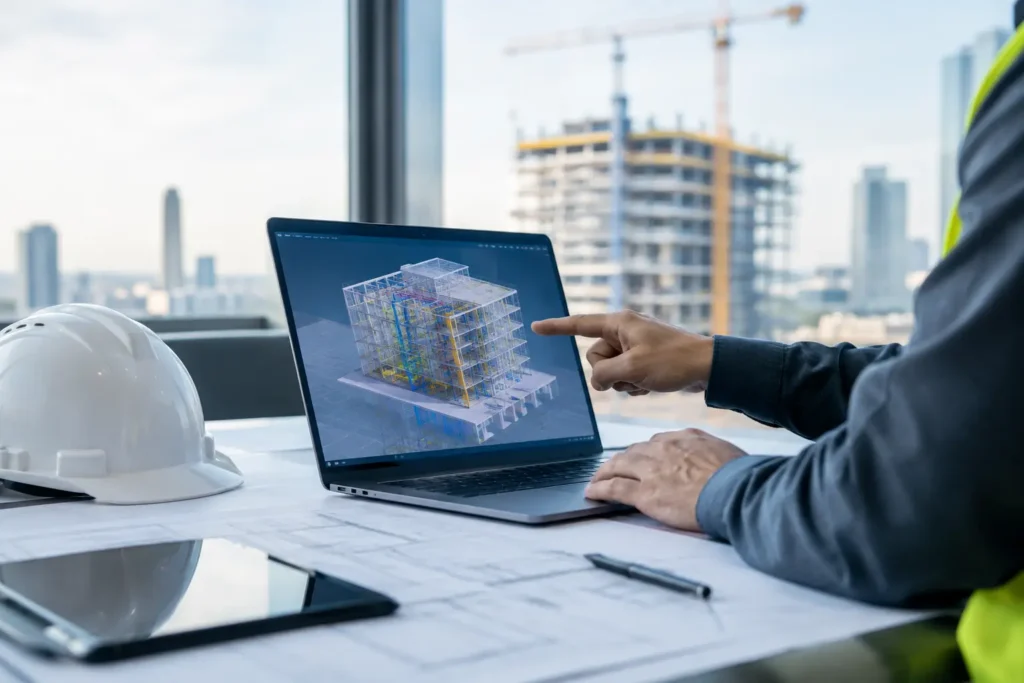
A project team discovers a service clash after ceiling installation, a concrete pour falls behind schedule, or an asset manager cannot find the latest equipment data. These are expensive moments because the information needed to prevent them existed somewhere, but not in a connected, usable model. Construction digital twin trends are changing that equation by connecting BIM data, site progress, systems information, and operational insight in one evolving digital environment.
For architects, engineers, BIM coordinators, MEP professionals, and project managers across Dubai and the GCC, this shift creates a clear career opportunity. Firms do not only need people who can create a 3D model. They need professionals who can organize reliable information, coordinate disciplines, review construction status, and help project teams make decisions from data.
Why Construction Digital Twin Trends Matter Now
A digital twin is not simply a detailed BIM model displayed in an impressive viewer. BIM creates and manages structured project information through design and delivery. A digital twin extends that information into a connected representation of a physical asset, potentially receiving updates from construction records, reality capture, sensors, building systems, and maintenance platforms.
The distinction matters because a model can be complete at handover yet become outdated within months. A useful twin is governed, updated, and connected to the questions teams need to answer: What has been installed? Which equipment is due for maintenance? Where are the high-risk work areas? What changed from the approved design?
In the UAE and wider MENA construction market, owners and contractors are under pressure to deliver complex airports, towers, hospitals, infrastructure, industrial facilities, and mixed-use developments with greater certainty. Digital twins support that objective, but only when the data foundation is practical. A poorly coordinated model with inconsistent naming, missing asset parameters, or unclear ownership will not become valuable merely because it is called a twin.
Trend 1: BIM Is Becoming the Data Backbone
The strongest trend is not replacing BIM. It is making BIM more accountable. Revit models, civil design data, coordination files, specifications, schedules, and asset registers increasingly need a common data structure that can serve design, construction, and operations.
This changes what employers expect from BIM teams. Modelers must understand shared coordinates, worksets, model health, level of development, parameter standards, classification, and file exchange requirements. BIM coordinators must understand clash workflows in Navisworks Manage, issue tracking, model federation, and the information requirements behind each deliverable.
A digital twin program succeeds when project information is structured early. It depends on agreed naming conventions, responsibility matrices, approval workflows, and asset data templates. This is less glamorous than a virtual walkthrough, but it is the work that makes later automation and analytics credible.
Trend 2: Reality Capture Is Closing the Site-to-Model Gap
Construction teams increasingly use laser scanning, photogrammetry, 360-degree site imagery, drones, and point clouds to compare site conditions with planned models. The practical value is straightforward: teams can verify installed work, measure quantities, document concealed conditions, and identify deviations before they become difficult to correct.
For a BIM professional, this creates demand for point-cloud registration, model-to-scan comparison, coordination of existing conditions, and clear reporting. The key trade-off is accuracy versus speed. A high-precision scan of a plant room can be essential for retrofit work, while routine progress monitoring may require faster, lower-detail capture. Professionals who understand the purpose of the data can choose the right workflow rather than collecting files that no one uses.
Trend 3: 4D and 5D Models Are Moving Closer to Field Decisions
Linking model elements to construction schedules creates 4D planning. Connecting quantities and cost information introduces 5D capabilities. These methods have existed for years, yet adoption is becoming more practical as teams seek tighter control over sequencing, procurement, labor access, logistics, and change impact.
The real opportunity is not producing an animation for a presentation. It is using model-based planning to test whether MEP installation can proceed before ceilings close, whether cranes and material routes create conflicts, or whether a revised design affects the critical path. This requires collaboration between planners, site engineers, quantity surveyors, and BIM teams.
For professionals moving into this area, scheduling literacy is as valuable as software ability. A visual sequence is only useful when it reflects a realistic construction plan. Project management knowledge, along with BIM coordination, gives candidates a stronger position in contractor and consultant teams.
Construction Digital Twin Trends in Operations
The long-term value of a digital twin often appears after handover. Facility teams want a reliable record of equipment, location, warranty details, maintenance history, and operating conditions. For large portfolios, this can reduce time spent searching for information and improve planning for repairs, replacements, and energy performance.
Smart buildings add another layer. Where appropriate, live information from building management systems, meters, occupancy tools, or sensors can be connected to asset data. This can help facilities teams investigate abnormal energy use, track equipment performance, and prioritize maintenance.
However, live data is not necessary for every asset or every project. A school, warehouse, residential tower, and airport have very different operational needs. The right twin is defined by the owner’s use cases, budget, data governance, and team capacity. A well-maintained asset information model may deliver more value than an expensive dashboard that receives no reliable updates.
Cybersecurity and Data Ownership Cannot Be Afterthoughts
As models connect to operational systems, cybersecurity becomes a project issue rather than only an IT issue. Teams need to decide who can access sensitive building data, which information belongs in the shared environment, how records are approved, and how data will be retained after contract completion.
This is especially relevant for healthcare, utilities, airports, government facilities, and industrial projects. BIM professionals may not be cybersecurity specialists, but they should understand access controls, document revision management, and the risks of sharing unverified or sensitive information. Digital maturity includes protecting the information that makes a twin useful.
Skills That Build a Digital Twin Career
A future-ready professional does not need to become an expert in every platform at once. The better approach is to build a connected skill set: modeling discipline, coordination capability, information management, and an understanding of project delivery.
For architectural, structural, and MEP professionals, Revit remains a core starting point because it develops the ability to create information-rich models. Navisworks Manage supports model aggregation, clash detection, and issue-based coordination. Civil 3D and InfraWorks are valuable for infrastructure and site-focused workflows, while Autodesk Forma supports early-stage analysis and planning discussions. Visualization tools can communicate intent, but technical accuracy must remain the priority.
Professionals should also learn to read BIM execution plans, understand employer information requirements, manage parameters, create schedules, and prepare models for construction and handover. Live-project practice matters because real coordination involves incomplete inputs, changing priorities, consultant comments, and disciplined communication.
Online BIM Learning for GCC and MENA Professionals
Working professionals in Dubai can combine classroom, online, or hybrid learning based on their project schedule. For learners in Oman, Saudi Arabia, Kuwait, Bahrain, Qatar, Egypt, and Sudan, instructor-led online sessions make it possible to build job-relevant BIM capability without postponing career progress or relocating.
A focused online program can cover Revit Architecture, Structure, or MEP modeling; family creation and parameters; worksharing and central model practices; BIM coordination using Navisworks Manage; clash reporting; quantity schedules; drawing production; and model-based project documentation. Advanced sessions can address COBie-oriented asset data, point-cloud workflows, 4D coordination concepts, model auditing, and project-specific coordination support.
CADD International delivers instructor-led BIM training for individuals and corporate teams with online, offline, and hybrid options from Dubai. One-on-one, premium private, customized, and advanced-topic sessions can be aligned to a learner’s discipline or an organization’s active project. Sessions can be delivered in English, Malayalam, Hindi, Tamil, Kannada, and Arabic, helping teams discuss complex workflows with greater confidence.
For corporate buyers, the most effective training starts with an assessment of current models, software roles, standards, and project objectives. A generic course may be suitable for foundational learning, but a contractor coordinating an MEP-intensive project needs exercises that reflect its actual coordination challenges. Customized training with project assistance can shorten the distance between learning a tool and applying it on site.
Build Capability Before the Requirement Becomes Urgent
Digital twins will not remove the need for experienced engineers, architects, and construction managers. They raise the value of professionals who can connect technical design knowledge with disciplined information management. Start with strong BIM fundamentals, then add coordination, field verification, and asset-information skills that match the type of projects you want to lead.
The next major project may not advertise for a “digital twin expert.” It will ask for a BIM coordinator who can control model quality, an MEP engineer who understands asset data, or a project professional who can turn information into action. That is where focused, practical training becomes a career advantage.