
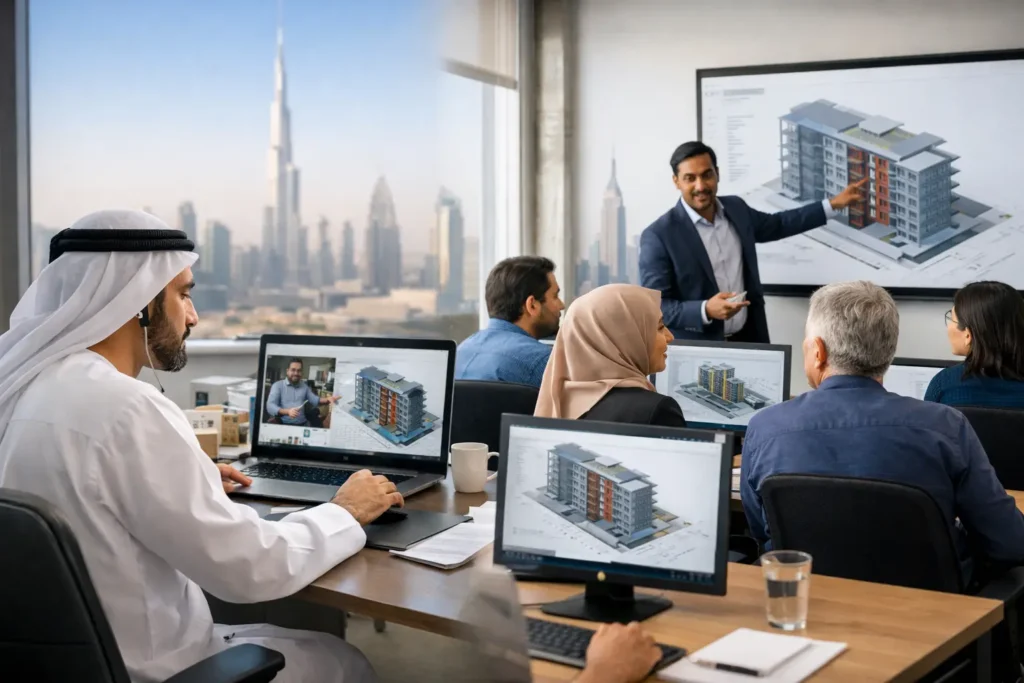
A BIM professional may need to coordinate an MEP model for a Dubai high-rise, review clashes before a contractor meeting, or build a Revit portfolio while working full time. That is why the decision around online versus classroom BIM learning is more than a preference about where to study. It affects your practice time, access to trainers, project exposure, confidence with software, and readiness for the hiring requirements of the UAE and GCC construction market.
For future-ready architects, civil engineers, MEP engineers, interior designers, and project coordinators, both learning formats can produce strong results. The right choice depends on your current software level, work schedule, learning habits, available equipment, and the type of BIM role you want to pursue.
What BIM Training Must Deliver
BIM training should not stop at learning Revit commands. Employers expect professionals who can understand coordinated models, drawings, quantities, documentation, model standards, multidisciplinary workflows, and clash detection. A course must turn software knowledge into practical delivery capability.
Whether the training is online or classroom-based, a quality BIM program should cover model creation, families, sheets, schedules, annotation, worksharing concepts, linked files, coordination, and project documentation. Advanced learners may also require Navisworks Manage for clash detection, BIM 360 or BIM Collaborate Pro for cloud-based collaboration, and discipline-specific workflows for architecture, structure, MEP, HVAC, or infrastructure projects.
The strongest learning environment also includes instructor feedback, structured assignments, practical project assistance, and a path toward building a professional portfolio. This is especially valuable in Dubai, Sharjah, Abu Dhabi, Ajman, and across the GCC, where contractors and consultancies increasingly need BIM-ready talent.
Online Versus Classroom BIM Learning: The Real Difference
Online BIM classes offer access and flexibility. Classroom BIM classes offer controlled practice and immediate physical support. Neither is automatically better. The value comes from how the program is delivered and how consistently the learner applies the training.
Online BIM Learning for Working Professionals
Online learning is an effective option for professionals managing site duties, design deadlines, shift work, or travel between project locations. Live instructor-led online sessions allow learners to attend from Dubai, other Emirates, or countries across the MENA region without losing access to a structured curriculum.
For a professional who already has a capable laptop, stable internet connection, and disciplined study routine, online BIM training can be highly productive. Screen sharing allows trainers to demonstrate modeling methods, inspect student files, correct family creation issues, and explain coordination procedures directly within the software environment.
Online sessions are particularly useful for learners who need focused support in a specific area. A mechanical engineer moving into HVAC BIM may need Revit MEP modeling, duct and pipe systems, equipment placement, schedules, and coordinated drawings. An architectural professional may focus on Revit architecture, documentation sets, material schedules, room data, and visualization. Targeted online sessions can address these needs without requiring a broad beginner-level course.
The trade-off is personal accountability. BIM is a practical skill. If a learner watches demonstrations but does not model independently, resolve errors, and submit exercises, progress will be slow. Online students must schedule hands-on practice between sessions and keep their project files organized.
Classroom BIM Learning for Hands-On Guidance
Classroom learning is often the best choice for beginners, career switchers, and learners who benefit from a focused technical environment. A classroom reduces distractions and creates a regular routine. When a student is stuck with views, levels, constraints, warnings, template settings, or a modeling sequence, the trainer can review the issue immediately.
This format is valuable for learners building confidence with computer-aided design tools for the first time. It also works well for professionals who want direct interaction with peers from architecture, civil, structural, mechanical, electrical, and interior design backgrounds. Questions raised by other participants often reveal real project situations that improve everyone’s understanding.
For learners in Dubai and Sharjah, classroom sessions can provide concentrated training with access to structured practice, instructor supervision, and career-focused guidance. The key benefit is momentum. Attending scheduled classes helps many learners complete projects and develop stronger habits than they would in a fully self-directed setup.
Classroom training does require travel and fixed attendance. It may be less convenient for professionals with long site hours or those living outside the UAE. For these learners, a live online or hybrid format can be a more realistic route to consistent progress.
When Hybrid BIM Training Is the Better Choice
Hybrid learning combines scheduled online instruction with selected classroom practice, assessments, project reviews, or one-on-one support. It suits learners who need flexibility but do not want to lose direct technical interaction.
A hybrid approach can be especially practical for Dubai-area professionals who travel frequently or work on active construction projects. They can attend core Revit, Navisworks, BIM coordination, or BIM Collaborate Pro sessions online, then use classroom time for complex exercises, portfolio reviews, or project assistance.
Corporate teams can also benefit from hybrid delivery. A contractor may require online training for distributed project teams, followed by on-site workshops focused on company templates, modeling standards, coordination protocols, and live project challenges. This approach supports real implementation rather than isolated software training.
Online BIM Sessions for GCC and MENA Professionals
Live online BIM learning gives professionals in nearby countries access to instructor-led technical training aligned with UAE and international project practices. It is a practical option for learners in Oman, Saudi Arabia, Kuwait, Bahrain, Qatar, Egypt, and Sudan who want to upgrade without delaying their career plans.
For Oman and Qatar, sessions can focus on Revit Architecture, Revit Structure, Revit MEP, construction documentation, and Navisworks coordination for building and infrastructure projects. Professionals in Saudi Arabia can benefit from advanced BIM coordination, multidisciplinary model review, clash reporting, BIM execution planning concepts, and cloud collaboration workflows for large-scale developments.
For Kuwait and Bahrain, online sessions can be customized for MEP coordination, HVAC layout development, electrical and plumbing modeling, quantity schedules, and coordinated drawing packages. Learners in Egypt and Sudan may choose foundation-to-advanced programs covering AutoCAD, Revit modeling, sheet production, family creation, rendering workflows, and portfolio projects that strengthen applications for regional opportunities.
Sessions can be conducted in English, Malayalam, Hindi, Tamil, Kannada, or Arabic, helping learners understand technical concepts clearly while working with globally used Autodesk software interfaces and project terminology. One-on-one, premium private sessions, customized modules, advanced-topic coaching, and project assistance are valuable when a learner has a specific deadline or needs support on a live design task.
Choose Based on Your Career Stage
A student preparing for a first architecture, engineering, or design role may gain more from classroom or hybrid learning because a structured environment builds fundamentals. A working engineer with AutoCAD experience may prefer live online Revit or BIM coordination training that fits around project responsibilities.
Experienced professionals should select training based on the role they want next. A draftsman aiming for BIM modeler responsibilities needs disciplined Revit production skills. An MEP engineer moving toward BIM coordination needs linked models, clash detection, issue tracking, and multidisciplinary communication. A project leader may need BIM 360, BIM Collaborate Pro, standards, model review, and team workflow knowledge.
Do not choose a format only because it is convenient. Choose the format that gives you enough time to practice, receive corrections, and complete real project-based assignments. A certificate has greater value when it is backed by confident software performance and a portfolio that shows how you solve project problems.
The Role of Instructor-Led Project Practice
Recorded videos can explain commands, but BIM proficiency is built through correction and repetition. Instructor-led training matters because real projects contain issues that tutorials often avoid: incorrect levels, broken links, inconsistent naming, missing data, coordination conflicts, incorrect schedules, and sheets that do not meet documentation standards.
CADD International Sharjah supports career-focused learners through instructor-led direct, online, and customized BIM training designed around practical software application. For eligible students, Autodesk educational software access can help create a proper practice environment, while project assistance and placement-oriented guidance add direction beyond the classroom.
Before enrolling, ask whether the program includes hands-on exercises, individual feedback, live-project concepts, advanced support options, and training relevant to your discipline. These details matter more than whether the class is delivered through a screen or inside a training center.
Your next BIM opportunity may begin with a Revit model, a coordinated drawing set, or a well-presented clash report. Choose the learning format that keeps you practicing consistently, then use every session to build proof of your capability.