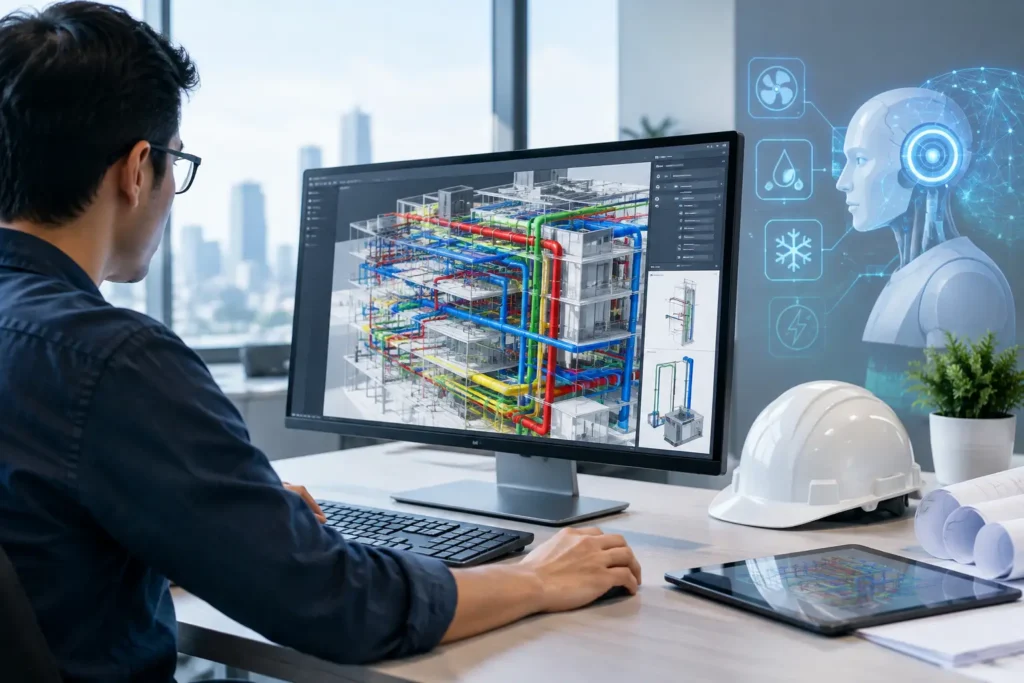
A congested ceiling void is where MEP decisions become real. A duct that appears acceptable in an isolated model may conflict with cable trays, sprinkler pipes, structure, maintenance clearance, or architectural intent once every discipline is coordinated. AI in MEP design is beginning to help engineers identify these risks earlier, review larger volumes of project data, and spend more time on technical decisions that require professional judgment.
For MEP engineers, BIM coordinators, HVAC designers, and electrical professionals across Dubai, Sharjah, Abu Dhabi, and the wider GCC, the question is no longer whether AI will enter the workflow. It already has. The more useful question is how to use it responsibly within Revit, Navisworks, BIM coordination processes, calculations, standards, and project delivery requirements.
Where AI in MEP Design Delivers Real Value
AI is most valuable when it supports repetitive, data-heavy, or comparison-based tasks. It can accelerate work, but it does not replace the engineer responsible for the design. MEP systems are governed by codes, client specifications, site conditions, constructability, safety, energy performance, and coordination with multiple disciplines. Those variables cannot be handed over to an automated output without review.
In early design, AI-supported tools can help teams examine alternatives for equipment locations, route planning, space allocation, and system options. For example, an HVAC engineer may compare several duct-routing approaches based on distance, available ceiling space, pressure-loss implications, and clashes with other services. The engineer still decides whether the result is practical, code-compliant, maintainable, and appropriate for the project.
During detailed modeling, intelligent features can assist with parameter checks, object classification, model-data cleanup, quantity extraction, and the detection of repeated inconsistencies. On a major healthcare, airport, residential tower, or industrial project, even a small reduction in manual checking can save meaningful coordination time.
AI can also make issue management more focused. Rather than treating every clash as equally urgent, teams can sort conflicts by probable impact, location, trade, severity, and repetition. This helps coordinators direct meetings toward clashes that can delay installation, rather than spending valuable time on minor tolerances or duplicate reports.
AI Is Not a Substitute for MEP Engineering
The biggest risk is assuming that a fast answer is automatically a correct answer. AI systems can propose incomplete calculations, misunderstand a project constraint, or produce content that sounds convincing without reflecting local standards. A generated duct size, cable selection, pump recommendation, or equipment schedule must always be checked by a qualified engineer against design criteria and approved documentation.
This is especially relevant in GCC projects, where project requirements may combine international codes, authority requirements, client standards, manufacturer information, sustainability targets, and local construction practices. A model can be technically clean while still being difficult to install or impossible to maintain. Engineers need to ask practical questions: Is there access for valves and dampers? Can the contractor fabricate this route? Does the selected equipment have the required service clearance? Has the fire strategy been respected?
AI also creates data-governance concerns. Project models, drawings, specifications, and client data should not be uploaded to unapproved public platforms. Organizations need clear rules on approved tools, file access, prompt usage, review procedures, and accountability. For corporate teams, AI adoption works best when it is part of a documented BIM execution and quality-control process, not an informal experiment.
The BIM Skills That Make AI Useful
Professionals do not need to become AI researchers to benefit from this shift. They do need stronger BIM fundamentals. AI produces better assistance when the underlying model is organized, information-rich, and built around reliable standards.
A future-ready MEP professional should be confident with Revit families, parameters, system modeling, schedules, worksharing, sheets, views, and model auditing. Navisworks Manage remains essential for model aggregation, clash detection, viewpoint creation, and coordination review. BIM 360 and BIM Collaborate Pro support controlled collaboration, issue tracking, version management, and project communication across distributed teams.
Data literacy is becoming equally valuable. Engineers should understand what information is required in a model, where it comes from, who owns it, and how it will be checked. This includes consistent naming, shared parameters, classification, equipment data, and clean schedules. If the source data is weak, AI-assisted analysis will be weak as well.
Automation skills add another layer of advantage. Revit workflows can be improved through rules-based checking, Dynamo concepts, spreadsheet integration, and structured templates. Not every engineer needs to write advanced scripts, but professionals who understand automation logic can identify repetitive tasks and communicate effectively with BIM managers, developers, and project teams.
A Practical Workflow for AI-Assisted MEP Coordination
The strongest approach is to introduce AI into a controlled workflow rather than using it as a shortcut. Start with a defined task, such as reviewing recurring clashes in a plant room, checking missing model parameters, organizing issue descriptions, or comparing alternative routing options.
First, establish the project inputs. Confirm the latest approved architectural, structural, and MEP models, coordination zones, LOD requirements, model coordinates, and issue priorities. Then use AI-supported analysis or automation to identify patterns, summarize information, or create a first-pass recommendation.
Next comes the essential stage: engineer review. The responsible designer or coordinator must validate the recommendation against drawings, calculations, specifications, code requirements, and installation realities. Document the final decision in the project’s approved issue-management process. This creates a traceable workflow instead of a hidden decision made by a black box.
Finally, measure the result. Did the method reduce clash-review time? Did it improve the quality of issue descriptions? Did it reduce rework in a specific area? The value of AI should be demonstrated through better delivery performance, not simply through the use of a fashionable tool.
Career Opportunities for MEP Professionals
The demand for professionals who can combine engineering judgment with BIM capability is increasing across construction, infrastructure, utilities, airports, facilities management, and real estate development. Employers need people who can model systems accurately, coordinate across disciplines, communicate issues clearly, and work within digital project environments.
For a mechanical engineer, this may mean progressing from 2D HVAC drafting into Revit MEP modeling, duct and piping coordination, equipment scheduling, and BIM coordination. For electrical engineers, it may involve circuiting, containment layout, lighting and power coordination, data-rich schedules, and clash resolution. For experienced professionals, the next step may be BIM leadership, model auditing, standards development, and digital-delivery management.
CADD International Sharjah supports this progression through practical BIM, Revit MEP, AutoCAD, Navisworks Manage, and coordination-focused learning designed around industry workflows. Students and working professionals can build software confidence alongside live-project understanding, project assistance, and placement-oriented career guidance.
Flexible Learning for GCC and MENA Professionals
Professionals do not need to relocate to begin developing these capabilities. Online, offline, and hybrid training options are particularly valuable for learners in Dubai, Sharjah, Ajman, Abu Dhabi, and Ras Al Khaimah, as well as professionals in Oman, Saudi Arabia, Kuwait, Bahrain, Qatar, Egypt, and Sudan.
A well-structured online session should go beyond screen sharing. Learners should work through Revit MEP interface fundamentals, mechanical and electrical system modeling, family placement, parameters, schedules, sheets, worksharing, Navisworks clash detection, coordination reporting, and BIM collaboration practices. Advanced sessions can focus on project templates, model audits, plant-room coordination, quantity schedules, issue management, and automation concepts.
For teams and individual professionals, one-on-one sessions, premium private sessions, customized corporate training, and advanced project assistance can address specific requirements. Instruction in English, Malayalam, Hindi, Tamil, Kannada, and Arabic makes technical learning more accessible to diverse project teams across the region. Corporate programs can also be delivered at client premises or online with valid software licensing arrangements.
AI will not make MEP engineering easier for professionals who avoid fundamentals. It will raise the value of those who can combine sound engineering, accurate BIM models, disciplined coordination, and intelligent use of technology. The next career advantage is not simply knowing an AI tool – it is being the professional who knows when to trust it, when to challenge it, and how to turn its output into a buildable MEP solution.